Starting the summer off with some true, patriot love, I finished Charlotte Gray's The Massey Murder this afternoon. It's not a typical title that I would choose, but I wanted to read it because:
a) Ever since Charlotte Gray demo'ed her razor-sharp wit and debating skills during CBC's Canada Reads 2013 debates, I've been promising myself I would read something of hers
b) It's non-fiction. My literary conscience tells me I need to read more of that.
c) It's KW's "One Book, One Community" selection for this year and the book nerd in me needs to be a part of these kinds of things.
So it turns out that Gray had every right to be critical of the books in the Canada Reads competition. She can write. Not only that, but she gives narrative to history that makes it more accessible for readers like me who are all about the story.
She also gives a voice to the voiceless in this book. Subtitled, "A Maid, Her Master and the Trial That Shocked a Country," this book offers best guesses as to what really happened when Bert Massey was shot by his maid when entering his house one February evening in Toronto, 1915. Gray highlights how Carrie's (the maid's) voice was hardly needed or given consideration in a male-dominated, morally-motivated and class-driven society.
I like this quote: "Servants are everywhere and nowhere in history. Carrie and women like her worked too hard to have any energy left for writing diaries or letters, and if any of them did manage to scribble down something, it has probably been lost. When a youngster like Carrie went into service, she walked into the shadows." (p. 90)
Gray does an excellent job of putting Carrie Davies' story in context. She provides background on the famous Massey family, the Toronto newspaper wars, class divisions, and Canada's place in WWI, which gives the story significance not only in the changing tides of 1915, but also today.
My one complaint about the book is that is the writing seems to mellow or loosen by the end. Initial chapters give the impression that the book is leading to something greater and more powerful at the end. But maybe that was intentional. I'll have to think on that a little longer.
Anyway, it's definitely worth reading and if anybody wants to join me at the September 2014 author visits where this book will be discussed, do let me know. ;)
I think one of my favourite part about books/reading in general is the community that grows and connects around a piece of writing. I'm always intrigued to find out which books are lining my friends' shelves or traveling around in their backpacks, especially if they're books with which I have a connection. A book in common is an instant bond... So...what am I reading? Stick around and see....
Showing posts with label history. Show all posts
Tuesday, July 01, 2014
Friday, January 17, 2014
I Read Canada Reads
I spent much of my Christmas holidays reading. That is to say, I read when I wasn't crocheting or watching Netflix or both. Basically, I hibernated for two weeks. And it was amazing. And I miss it already.
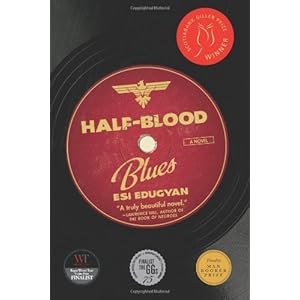
Digging into the Canada Reads books has become my winter mission. I started with Esi Edugyan's Half-Blood Blues.
This is a fascinating story that dropped me into a world I didn't know existed and had never even considered: the Jazz scene in Germany during the Nazi regime. It's a complicated emotional portrayal of guilt and regret from a character who was ultimately powerless, but who spends his life blaming himself for what he should have done.
As well-crafted (and well-researched) a novel as it may be, the only thing Canadian about this book is its author. Also, it already won the Giller Prize in 2011 and was a finalist for the GGs and the Man Booker. I kind of feel like this book has already received its public accolades. So while it's a great book, it's not the underdog I'm hoping to cheer for in this year's Canada Reads competition.
Shelagh Rogers did a great interview with Esi Edugyan for her radio show, "The Next Chapter" and it provided some great aural distraction while I did several loads of laundry one day.
After Half-Blood Blues, I decided to tackle The Orenda. I've never read anything by Joseph Boyden, but I feel like his books follow me around. I find them on tables in bookstores with signage like, "The Best Novels You've Never Read." The Orenda has also received a lot of press coverage, so I decided to give it a go.
I was glad I warmed up with Half-Blood Blues: compared to Edugyan's novel, The Orenda is a brick. This novel is narrated by three characters: a Jesuit priest, a Huron warrior, and a young aboriginal woman taken from another village who becomes the warrior's 'adopted' daughter. It was difficult to ease into--kind of like a fast-paced conversation that began without you--but once the narrators' stories began to intertwine, it was difficult to set the book down. (Bonus: You can build some good muscles with this one! It's large, available only in heavy hardcover, and hard to quit!)
A review from Quill and Quire comments on The Orenda's "blockbuster feel," adding, "The Orenda will be this year's Book of Negros, I think." We could definitely do worse for entertaining, Canadian historical fiction!
Entertaining as it may be, it's definitely not fluff. One impactful episode in the novel occurs when the priest loses the wampum that the warrior was to present to another tribe as part of a peace negotiation. He bemoans:
- "I have lost my people's story, my gift to the ones who are our enemy, in the hope of changing that course." (p. 108)
This implies that Canadian history played out the way it did because the stories of certain peoples were lost or dismissed. (Yikes. This entry is starting to sound like a high school essay.)
Where Boyden's novel differs from many of the aboriginal themed/flavoured/inspired novels that I have read (and they are a genre of personal interest...I have read many!) is that the picture he paints of aboriginal history is much more brutal and complicated than the peaceful, idealistic scene that is typical. I will be very interested to hear the commentary that accompanies this novel in the Canada Reads debates. I'm hoping this book makes it to the final rounds because I know it will generate great discussion.
I guess I should stop here. More Canada Reads comments to come.
Labels:
Canada Reads,
canadian,
fiction,
historical novel,
history,
literary competition,
novel
Tuesday, May 01, 2007
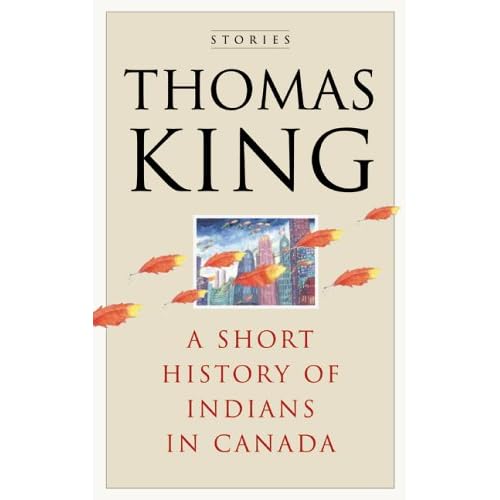
A Short History of Indians in Canada
Thomas King is, without a doubt, the most featured author in my list of books. There is, however, good reason for that! He writes satire unlike any other, and I just can't get enough salt-in-the-wound humour these days.
I've just finished, A Short History of Indians in Canada. The title alone was enough to stir up controversy among those who saw me reading it, the common response being a nervous, "Er...what is that book about?" (The best answer I've been able to come up with, for the record, is, "Well, the title says it all.")
In this collection of short stories, you will find:
-reverence and irreverance, sometimes at the same time.
-King writing in a woman's voice (only for 1/2 dozen pages or so, but I believe it's a first)
-(some) stories that have no obvious connection to aboriginals in Canada
-broken families; broken relationships; broken promises
-snappy jokes
-jarring juxtapositions (I'm still working on the incorporation of Star Trek into Canadian history...)
A Short History is a potentially quick read that should, in my opinion, be read slowly. I've been savouring it for about three weeks, and I think I'll go back and read some parts again.
Drawing on the high school history class theme of my Beauty Tips post, I think that some of these stories would fit much better in history class than English class...and I'm going to start sneaking copies into my would-be-history-teacher friends' bookshelves just to see what might happen.
Labels:
aboriginal,
canadiana,
fiction,
history,
humour,
satire,
short stories
Monday, April 30, 2007
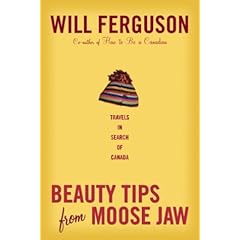
Beauty Tips From Moose Jaw
I've just finished a course on teaching writing. One of the main questions we struggled with in our twice-weekly class discussions was how to escape from the dreaded 5-paragraph essay format when creating writing assignments. I'd like to give a copy of Will Ferguson's Beauty Tips From Moose Jaw to each and every high school teacher with any kind of connection to teaching Canadian history or geography. Ferguson gives an excellent example of how writing about history doesn't have to be boring! (In fact, it can even be funny!)
My friend Lynne says that this book is what inspired her to travel across Canada. I can see why! Ferguson does a good job of making the everyday interesting. (Read this book and you'll have a new level of respect for the cultural significance of a grilled cheese sandwich, for example.) Continuing on the grilled cheese theme, some chapters in the book are a little...dull and synthetic. Those would be the ones stuffed into the middle--the three-chemicals-short-of-a-garbage-bag filling that holds the gloriously toasted bread (ie. the opening and ending chapters) together.
My advice to somebody who's thinking about reading this book: if a chapter gets boring, skip on ahead to one that looks more interesting...you're not going to miss much! This would be a good book to find on tape for a road trip, or to read at a summer cottage....or even to read aloud with a group of friends, if you're into that sort of thing. Ferguson's skill with language makes this a book that sounds good (ie. even funnier) out loud.
Another disappointment I had with the book is that so many good sights and sites are skipped over. I suppose that could be part of the point of the whole book. For each and every, "Oooooh. I wish he'd included a chapter about...." there's a fascinating history assignment waiting to be written.
Subscribe to:
Posts (Atom)