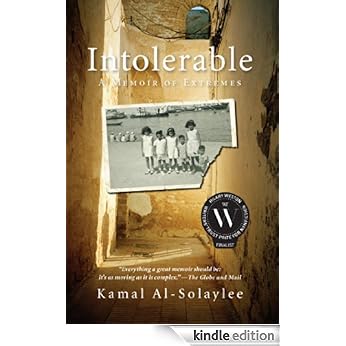
 I really wanted to like this book more than I did. The gist of it--a memoir telling one man's story of his escape from the oppression (religious, political, anti-gay) of Yemen/Egypt to live an honest and authentic life in the UK and Canada--sounds like it should be a fascinating story. And while the facts are interesting, the story is dull and repetitive. For me, it lacked emotional connection. I trucked on through because I wanted to give this Canada Reads contender a fair shake, but my whole experience reading it (save maybe for the last chapter and who's to say for sure whether I was suddenly 'feeling it,' or just glad the whole experience was almost over) felt more like required reading than anything fun. I'm disappointed. I think that's all I'm going to say about this one.
Showing posts with label canadian. Show all posts
Showing posts with label canadian. Show all posts
Sunday, March 15, 2015
Intolerable: A Memoir of Extremes
I really wanted to like this book more than I did. The gist of it--a memoir telling one man's story of his escape from the oppression (religious, political, anti-gay) of Yemen/Egypt to live an honest and authentic life in the UK and Canada--sounds like it should be a fascinating story. And while the facts are interesting, the story is dull and repetitive. For me, it lacked emotional connection. I trucked on through because I wanted to give this Canada Reads contender a fair shake, but my whole experience reading it (save maybe for the last chapter and who's to say for sure whether I was suddenly 'feeling it,' or just glad the whole experience was almost over) felt more like required reading than anything fun. I'm disappointed. I think that's all I'm going to say about this one.
Tuesday, February 03, 2015
When Everything Feels Like The Movies: Ra-rah for YA

When Everything Feels Like The Movies is a YA novel starring (no, really...starring) Jude Rothesay, a teenager with nowhere to fit in or belong in his small town. Jude is gay. He likes dressing up in women's clothing. His mother is an aging stripper with low enough self-esteem to keep welcoming his abusive, addict stepfather back into their lives. His bio dad is AWOL. His best friend betrays him. Those who love him do it so secretly or in such a twisted way that it ends up being just as hurtful as hate.
And he's bullied. Seriously bullied. End-up-in-the-hospital kind of bullied. But he kind of gives it right back, publicly taunting others. He distances himself from reality by imagining he's living a Hollywood life, where his "haters" are just the price he pays for fame.
I wanted to love this book. Instead, I like what it's trying to do. (It's a strong kind of like. As in, I don't want to marry this book, but I would invite it to my intimate wedding.) The melodrama was a bit hard to read at times, even though I get that that's the point. Raziel Reid has created a character who is pitiable, lovable, and lothable all in one paragraph.
Do you want to read it yet? You should. I'll warn you: it's graphic. But that's kind of the point, too. Reid is trying to get you to feel something as you read this book, and its not exactly a comfortable feeling.
It's not the first time that Canada Reads has featured a YA selection. I think it was 2009 when Fruit was nominated...and that's still one of my favourites. So maybe after you read When Everything Feels Like The Movies, you could read Fruit. Read them both. And weep. Because that's kind of the point.
Sunday, January 25, 2015
The Trail Of The Conestoga

Were it not my self-assigned "required reading," I may never have picked this book up, but I'm glad I did. The Trail of the Conestoga by Mabel Dunham tells the story of the migration of Mennonites from Pennsylvania to what is now Waterloo County in the early 1800s.
It was the author's bio on the back cover that caught my attention. Mabel Dunham was a librarian of the KPL and started the children's section there. She was the first president of The Canadian Federation of University Women, and the particular edition of the book I bought was published to mark the 50th anniversary of the KW chapter.
There was something undeniably 1940s Canadian about this novel. Beyond its musty smell, it's packed with little history lessons thinly disguised as back-and-forth banter between characters ("Why, it's Isaac Brock!" / "Who's that?") and morality tales spun so thick you trip over them. Dunham's choice to focus on the Mennonites' reasons for and history as conscientious objectors would have been an interesting and bold addition to a novel first published in 1942, right in the thick of the second World War. She consistently portrays females as strong, wise, and patient and takes a passive-aggressive approach to the issue of gender roles. (Love this gem: "...she pressed her lips together and held her peace. To begin a conversation was a privilege she usually accorded her husband, whom the good St. Paul had set up in some uninspired moment as the head of the household. She was quite satisified so long as she had the last word."
This book is charming. I was thinking about recommending it as a title for my book club to consider. Unfortunately, it's not in print anymore. A quick search on amazon shows that used copies are selling for a pretty penny. (This makes me all the more proud of my $2.00 purchase from none other than the MCC's Thrift on Kent!) So I guess I'll just offer up this book on loan for anyone who wants to read it. I think librarian/author Mabel Dunham would approve.
Friday, January 17, 2014
I Read Canada Reads
I spent much of my Christmas holidays reading. That is to say, I read when I wasn't crocheting or watching Netflix or both. Basically, I hibernated for two weeks. And it was amazing. And I miss it already.
Digging into the Canada Reads books has become my winter mission. I started with Esi Edugyan's Half-Blood Blues.


Digging into the Canada Reads books has become my winter mission. I started with Esi Edugyan's Half-Blood Blues.
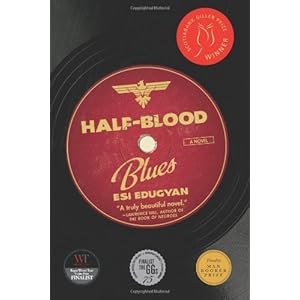
This is a fascinating story that dropped me into a world I didn't know existed and had never even considered: the Jazz scene in Germany during the Nazi regime. It's a complicated emotional portrayal of guilt and regret from a character who was ultimately powerless, but who spends his life blaming himself for what he should have done.
As well-crafted (and well-researched) a novel as it may be, the only thing Canadian about this book is its author. Also, it already won the Giller Prize in 2011 and was a finalist for the GGs and the Man Booker. I kind of feel like this book has already received its public accolades. So while it's a great book, it's not the underdog I'm hoping to cheer for in this year's Canada Reads competition.
Shelagh Rogers did a great interview with Esi Edugyan for her radio show, "The Next Chapter" and it provided some great aural distraction while I did several loads of laundry one day.
After Half-Blood Blues, I decided to tackle The Orenda. I've never read anything by Joseph Boyden, but I feel like his books follow me around. I find them on tables in bookstores with signage like, "The Best Novels You've Never Read." The Orenda has also received a lot of press coverage, so I decided to give it a go.
I was glad I warmed up with Half-Blood Blues: compared to Edugyan's novel, The Orenda is a brick. This novel is narrated by three characters: a Jesuit priest, a Huron warrior, and a young aboriginal woman taken from another village who becomes the warrior's 'adopted' daughter. It was difficult to ease into--kind of like a fast-paced conversation that began without you--but once the narrators' stories began to intertwine, it was difficult to set the book down. (Bonus: You can build some good muscles with this one! It's large, available only in heavy hardcover, and hard to quit!)

A review from Quill and Quire comments on The Orenda's "blockbuster feel," adding, "The Orenda will be this year's Book of Negros, I think." We could definitely do worse for entertaining, Canadian historical fiction!
Entertaining as it may be, it's definitely not fluff. One impactful episode in the novel occurs when the priest loses the wampum that the warrior was to present to another tribe as part of a peace negotiation. He bemoans:
- "I have lost my people's story, my gift to the ones who are our enemy, in the hope of changing that course." (p. 108)
This implies that Canadian history played out the way it did because the stories of certain peoples were lost or dismissed. (Yikes. This entry is starting to sound like a high school essay.)
Where Boyden's novel differs from many of the aboriginal themed/flavoured/inspired novels that I have read (and they are a genre of personal interest...I have read many!) is that the picture he paints of aboriginal history is much more brutal and complicated than the peaceful, idealistic scene that is typical. I will be very interested to hear the commentary that accompanies this novel in the Canada Reads debates. I'm hoping this book makes it to the final rounds because I know it will generate great discussion.
I guess I should stop here. More Canada Reads comments to come.
Sunday, July 14, 2013
More Canadiana in Germany (#bookaday 9)
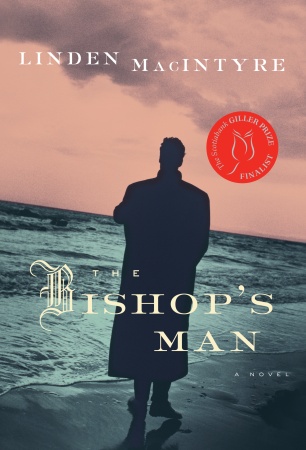
I just had to figure out a way to work the carnal vs. spiritual thing into a post about Linden MacIntyre's The Bishop's Man, the latest novel to entertain my brain. The book is about a Canadian Catholic priest who specializes in keeping the notorious "sins of the Fathers" out of the spotlight. (Ah? You see the spiritual vs. carnal connection now?) This novel won the 2009 Giller Prize. And yes, it's CBC's Linden MacIntyre who co-hosts the fifth estate. So basically you're looking at a low-risk investment here if you're after a good read. Guaranteed return on your time, folks.
What I thoroughly enjoyed about MacIntyre's writing was his ability to capture thought patterns. He brings the reader in, out and through narrator Father McAskill's layers of memories and creates a collage of detail that allows the reader to understand McAskill's past and present as one complicated, organic whole.
The language is beautiful as well. MacIntyre is able to call attention to words through protagonist Father MacAskill's love of of them. The story is anchored in Canadian geography and explores themes of family, community and masked identity.
I stood in the hotel room bathroom to finish this one. (It was late. My husband needed sleep and I needed light to get through the last few chapters.) It's that good. Five out of five stars for this spiritual read.
Friday, July 12, 2013
Novel Thoughts (#bookaday 8)
When I read novels, I start a running narration in my head and suddenly life gets a lot more interesting. The narration tends to adopt the style of whoever I happen to be reading at the moment. Right now, it's Lisa Moore. She has, as my husband observed, glancing over the pages as I took a moment to rest my eyes and return to reality on the airplane, a tendency towards long sentences that can themselves constitute a paragraph.
Lately, I've been feeling guilty about reading novels and trust me, it has nothing to do with their contents. Well, not exactly. I feel like I'm being too indulgent with my time, when there's much more I could be doing or learning. I'm not sure where this idea came from, because it's absolute nonsense. The world of book lovers continually shares the benefits of reading novels via social media. I've been hoarding these bits of information in an attempt to quell my guilt. Like a recent article about how reading novels makes us better thinkers--more accepting of ambiguity and less likely to make snap decisions.
But, back to Lisa Moore and Alligator. I read February this past February (fitting, no?) since it was nominated for Canada Reads 2013...and I discovered another Canadian author to add to my list of True Patriot Loves. No surprise, Moore's novel won the competition. When I found her book Alligator amidst the hoard of novels at the Elora Book Sale, I snapped it up with excitement (and maybe a bit of reptilian instinct) and I've actually been putting off reading it until summer vacation, the way some people save a bottle of wine to open at just the right moment.

This novel explores the sometimes dull, sometimes heart-wrenching, sometimes beautiful agony of the "you're-all-I-have" relationships that tether us to time, place and circumstance. In the same storytelling style as February, Moore's narration is delivered through several characters, their story threads interwoven and intersecting even if they are oblivious to it. This novel is less about plot and more about character and will have you contemplating relationships and how it's possible both to stay and run away, to both grieve the loss of those existing right in front of you and be ever in the presence of the dead.
(Was that vague enough for you? ;) Long live the novel. Let ambiguity reign.)
Lately, I've been feeling guilty about reading novels and trust me, it has nothing to do with their contents. Well, not exactly. I feel like I'm being too indulgent with my time, when there's much more I could be doing or learning. I'm not sure where this idea came from, because it's absolute nonsense. The world of book lovers continually shares the benefits of reading novels via social media. I've been hoarding these bits of information in an attempt to quell my guilt. Like a recent article about how reading novels makes us better thinkers--more accepting of ambiguity and less likely to make snap decisions.
But, back to Lisa Moore and Alligator. I read February this past February (fitting, no?) since it was nominated for Canada Reads 2013...and I discovered another Canadian author to add to my list of True Patriot Loves. No surprise, Moore's novel won the competition. When I found her book Alligator amidst the hoard of novels at the Elora Book Sale, I snapped it up with excitement (and maybe a bit of reptilian instinct) and I've actually been putting off reading it until summer vacation, the way some people save a bottle of wine to open at just the right moment.

This novel explores the sometimes dull, sometimes heart-wrenching, sometimes beautiful agony of the "you're-all-I-have" relationships that tether us to time, place and circumstance. In the same storytelling style as February, Moore's narration is delivered through several characters, their story threads interwoven and intersecting even if they are oblivious to it. This novel is less about plot and more about character and will have you contemplating relationships and how it's possible both to stay and run away, to both grieve the loss of those existing right in front of you and be ever in the presence of the dead.
(Was that vague enough for you? ;) Long live the novel. Let ambiguity reign.)
Sunday, April 08, 2012
The Prophet's Camel Bell

The New Canadian Library (NCL) has been around since 1958. It's a collection of the classics of Canadian Literature. I like how all the books are the same size and style, so they fit together so nicely on my bookshelves. However, the publisher keeps re-releasing the library with a new set of covers, so I have several mini-collections. I know you can't judge a book by its cover, but I think you can justify having several versions of the same book on your shelf just because the covers are a little different.
Today, I started in on The Prophet's Camel Bell. I actually read the first two chapters aloud to Dan while he did the dishes. (I think I got the better end of that deal, but he says he likes hearing me read.) Since it's a mix of Margaret Laurence's commentary on human nature (my love) and travel narrative (his), it was an enjoyable read for both of us.
Started: Sunday, April 8, with a mug of home-brewed coffee in hand (we will not buy Our Compliments Espresso again!)
Finished: in progress...
I finally settled on four titles (but it was a complete exercise in restraint):
- The Prophet's Camel Bell by Margaret Laurence
- The Fire-Dwellers by Margaret Laurence
- The Equations of Love by Ethel Wilson
- The History of Emily Montague by Frances Brooke ("Canada's first ever novel")
 |
| NCL editions, from oldest to newest. |
Started: Sunday, April 8, with a mug of home-brewed coffee in hand (we will not buy Our Compliments Espresso again!)
Finished: in progress...
Subscribe to:
Posts (Atom)